


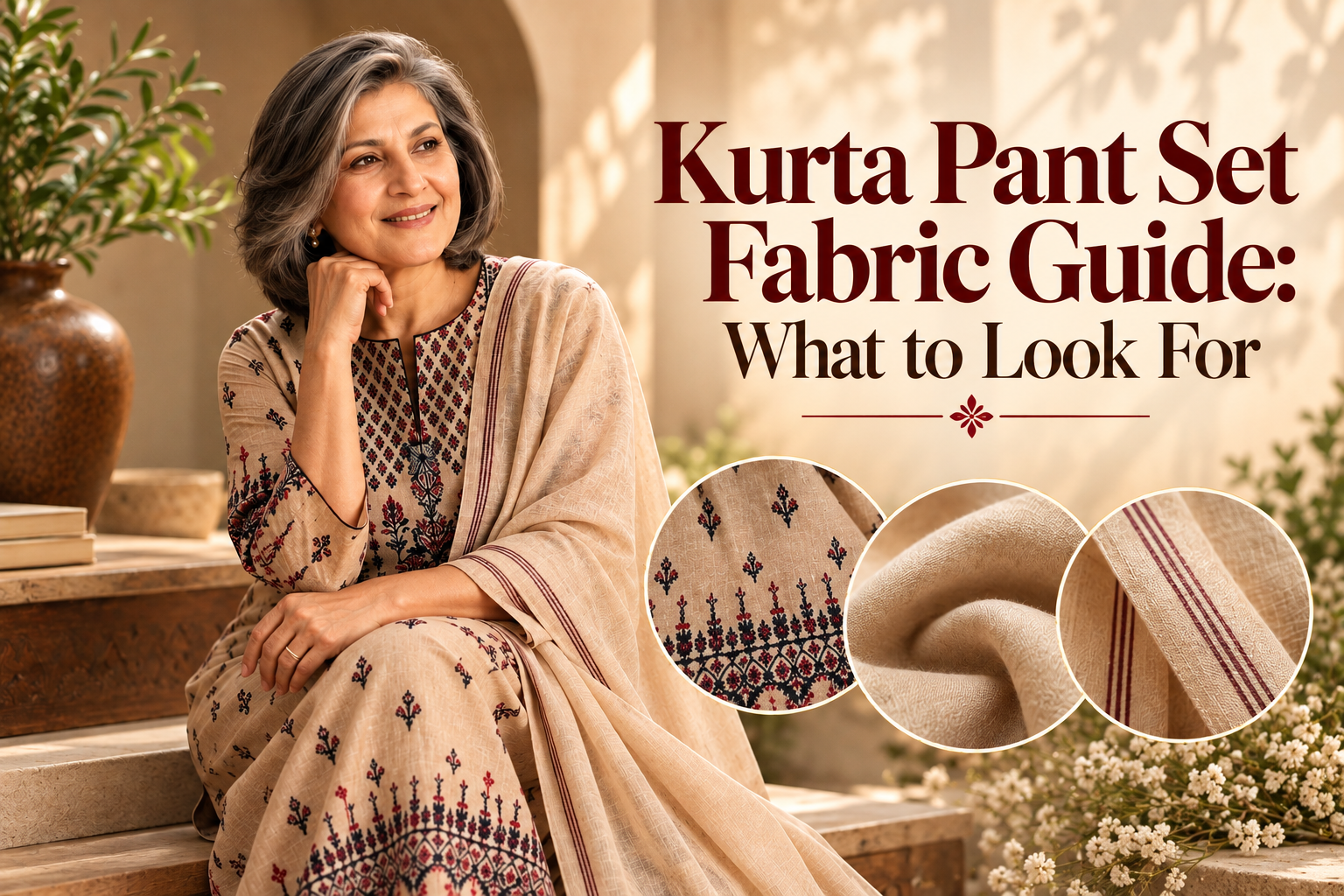
Every great kurta pant set begins with the right fabric, and understanding kurta set material is the quickest way to find the best fabric for kurta dressing in your climate, your budget and your lifestyle. A beautiful cut or a lovely embroidery can catch your eye in a photograph, but it is the cloth that decides how the outfit feels at nine in the morning, how it behaves at six in the evening and how it looks after its tenth wash.
I have spent more than twenty years writing about clothes, and if there is one lesson that has stayed with me, it is this: women rarely return a kurta set because of its colour or silhouette. They return it because the fabric itch, clung, wrinkled, faded or simply did not feel the way the picture promised. This guide exists to prevent that disappointment. Whether you are browsing a kurta pant set collection for office days, a family function or a festive weekend, the notes below will help you read a product page like an expert. If you would like to see how thoughtfully chosen fabrics come together in finished pieces, you can also explore the full range at Baivee.
Why Fabric Matters More Than Anything Else
Think about the last time you wore an outfit that felt wrong. Perhaps the kurta stuck to your back in the afternoon heat. Perhaps the pants bagged at the knees by lunchtime. Perhaps the dupatta kept slipping off your shoulder because the fabric was too slippery. None of those problems came from design. All of them came from fabric.
Fabric controls four things that matter in everyday wear. The first is comfort, which includes breathability, softness against the skin and how well the cloth manages sweat. The second is drape, meaning how the kurta falls from your shoulders and how the pants move when you walk. The third is durability, which tells you how many washes, wears and long travel days the set can survive. The fourth is occasion fit, because a fabric that looks perfect at a wedding may feel absurd at a Monday meeting.
When you evaluate any kurta set for women, ask yourself two plain questions before anything else. Where will I wear this, and for how many hours at a stretch? Honest answers to those questions narrow your fabric options immediately. A woman who spends ten hours in an air conditioned office needs something very different from a bride’s cousin who will dance through a humid evening sangeet.
Cotton: The Everyday Hero
If someone asks me for the best fabric for kurta wear in general, I almost always begin with cotton. It is breathable, soft, absorbent and forgiving, which is why a cotton kurta pant set for women remains the most reliable choice for Indian weather.
Not all cotton is the same, though, and this is where many buyers get confused. Pure cotton kurta sets are made from cotton fibre alone, with no polyester or other synthetic blend. They feel cool on the skin, soften beautifully with washing and let your body breathe. Within pure cotton, you will meet several weaves worth knowing.
Cambric and poplin are crisp, smooth and structured. They hold shape well, which makes them popular for office kurta sets and straight cut designs. Mulmul is feather light and airy, almost like wearing a breeze, and it is a treat in peak summer though it wrinkles easily and can be sheer. Voile sits between the two, sheer and fluid but a little sturdier than mulmul. Cotton slub has a slightly uneven, textured surface that gives a casual, handcrafted look. Khadi is handspun and handwoven, with a distinct earthy texture that gets softer over time.
When you shop for a cotton kurta set for women, check the thread count and weave rather than trusting the word cotton alone. A loosely woven cotton may be wonderfully airy but can lose shape quickly. A tightly woven cotton will feel crisp at first and can seem stiff, but it usually lasts longer. Neither is wrong. They simply suit different needs.
The big advantage of cotton kurta sets is how well they handle daily life. You can wash them at home, iron them on a high setting and wear them again without fuss. The honest drawback is wrinkling. Pure cotton creases easily, so if you hate ironing, consider a cotton blend or a fabric with a bit of crinkle built into the finish.
Cotton also takes colour beautifully. A white kurta set looks crisp and clean, an off white kurta feels softer and more elegant, and a pastel kurta in mint, peach or powder blue looks fresh on cotton in a way that few other fabrics can match. A yellow kurta set for women looks cheerful and sunlit on cotton, while a sky blue kurta feels calm and breezy. If you love a printed look, a floral print kurta set on cotton remains one of the easiest, prettiest choices for daytime wear.
Linen and Cotton Blends: Relaxed Without Looking Careless
Linen has become one of the most loved materials for modern ethnic wear, and it is easy to see why. It is made from flax, it is naturally cool and it has that unmistakable relaxed texture that makes even a simple kurta pant set look refined.
The surprise for many buyers is that linen wrinkles, and it wrinkles a lot. This is part of its charm. A slightly rumpled linen kurta looks intentional, almost editorial. If you want the linen feel with less creasing, look for a cotton linen blend. These blends soften the roughness, reduce wrinkles and often cost less than pure linen. They also drape more gently, which suits straight kurtas and tapered pants.
Linen works best in warm, dry weather. In very humid cities, it can feel slightly heavy once damp, so keep the weight light. Choose neutral and earthy shades such as sand, olive, stone, off white and soft grey. A grey kurta in linen has a quiet, architectural quality that is hard to replicate in other fabrics.
One practical tip from long experience: always wash linen gently and avoid harsh drying. Over time it becomes softer and more beautiful, but rough treatment shortens its life.
Chikankari: A Craft That Deserves the Right Fabric
Few things in Indian fashion are as graceful as chikankari, the delicate shadow work embroidery that originated in Lucknow. A chikankari kurta set is timeless, but the experience of wearing one depends entirely on the base fabric underneath the embroidery.
On cotton, chikankari looks crisp, summery and everyday friendly. A white chikankari kurti on soft cotton or mulmul feels like the definition of effortless. On georgette, chikankari becomes more fluid and festive. A georgette chikankari kurti drapes beautifully, moves with you and looks graceful in photographs, which is why it is such a favourite for gatherings and daytime celebrations. On silk or silk blends, the embroidery takes on a richer, more formal personality.
When you inspect a chikankari kurta set, look closely at the stitching. Real chikankari has clean, even stitches that lie flat, and the reverse side should look tidy rather than tangled. The fabric should be firm enough to hold the embroidery without puckering. If the cloth is too thin for dense work, the embroidery can pull and ripple after a few washes. A heavier georgette or a well woven cotton usually handles it better.
Care matters too. Chikankari pieces generally prefer gentle hand washing or a delicate cycle, and they should be dried in shade. Treat them kindly and a good chikankari set can stay in your wardrobe for years.
Silk and Silk Blends: Richness With a Purpose
A silk kurta set carries a sense of occasion. The natural sheen, the smooth fall and the faint rustle of good silk make it ideal for weddings, pujas and special evenings. But silk is a broad family, and it helps to know the members.
Pure silk such as mulberry silk is soft, lustrous and luxurious, but it needs careful handling, dry cleaning and storage. Raw silk or dupion has a crisp, slightly nubby texture and holds structure well, which suits embroidered and festive designs. Art silk or silk blends cost less and often resist creasing better, though they can feel warmer and less breathable. Chanderi, a lightweight blend of silk and cotton, offers a lovely translucent glow with far more comfort for warm weather than heavy silks.
For a festive kurta set, silk is often the first fabric people consider, and rightly so. A gold kurta in silk or a silk blend catches evening light in a way that feels celebratory without looking loud. A wine colour kurta in raw silk looks deep and dignified. A red kurta set with dupatta in silk is practically a festival all on its own.
Just remember that silk is not ideal for hot, sweaty conditions. If you plan to wear it for long hours in a humid climate, choose a lighter weave like Chanderi or a silk cotton blend. And always test how it feels against your skin, because some silks feel slightly stiff before they are broken in.
Georgette, Crepe, Chiffon and Rayon: The Flowy Family
If drape is what you want, this group delivers. These fabrics move, flutter and fall softly, which makes them popular for designer kurta sets and modern silhouettes.
Georgette has a light, slightly crinkled texture and a beautiful fall. It is semi sheer, so it usually comes lined. It works well for kurta palazzo set styles, flared kurtas and embroidered pieces. Crepe has a subtle pebbly texture, drapes nicely and resists wrinkles better than cotton, which makes it great for travel and long workdays. Chiffon is the lightest and most delicate of the group, lovely for dupattas but less practical for the main kurta unless well lined. Rayon and viscose feel soft and silky, take dyes brilliantly and cost less than natural silk. They also breathe better than polyester, though they can shrink and weaken when wet, so follow the wash instructions carefully. Modal, a refined form of rayon, feels even smoother and holds up better to repeated washing.
Flowy fabrics are especially kind to the body, because they skim rather than cling. They also photograph well, which is partly why you see them so often online. Still, check for lining. An unlined georgette kurta can reveal more than you want in bright light, and a poorly lined one can trap heat.
At this point, it is worth stepping back to see how fabric fits into the larger story of ethnic dressing. If you want to understand why the kurta and pant combination feels so right for modern wardrobes, this piece on kurta pant sets reimagined as traditional wear for the modern woman explores the idea beautifully, and it pairs well with everything we are covering here.
Velvet, Wool and Warm Fabrics for Cooler Months
Winter asks for a different approach. A winter kurta set for ladies needs warmth, structure and a touch of richness, and a few fabrics do this job beautifully.
Velvet is the great winter celebration fabric. A velvet kurta set with dupatta looks regal, catches the light with a deep glow and suits weddings, receptions and festive dinners. Jewel tones like bottle green, wine, navy and deep maroon look striking in velvet. The catch is weight. Velvet is warm, so it is wonderful in cold weather and uncomfortable in warm rooms. Check that the lining is smooth and that the pile feels even, with no bald patches.
Wool and wool blends make a woolen kurta set with dupatta a cosy, practical winter outfit. Pure wool can feel scratchy to some skin types, so look for soft blends or merino based fabrics. A wool blend with a smooth finish gives warmth without itch. Pashmina inspired weaves and acrylic wool blends offer softness at a lower cost, though they are less breathable.
Jacquard and brocade bring pattern and body, and they are useful when you want a festive look that feels structured and warm. A kurta pajama jacket combination in these fabrics gives a layered, elegant look that works beautifully for cold evenings.
When shopping for winter sets, think in layers. A thin cotton or silk base with a warm jacket or shawl often works better than one very heavy outfit, because it lets you adjust as indoor and outdoor temperatures change.
Embroidery, Prints and Craft Textiles: Reading Beyond the Base Cloth
Many of the prettiest kurta sets are defined by their surface decoration, and the decoration changes how the fabric behaves.
An embroidered kurta needs a base that can carry stitching without puckering. Dense embroidery adds weight and stiffness, so on a light fabric it may pull the cloth downward. Check that the inside is finished neatly, that threads are not scratchy against the skin and that the embroidery is secured at the edges. Thread work on cotton or georgette is generally comfortable. Heavy zari or sequin work looks stunning but can be itchy and warm, so look for soft backing.
Bandhani is a tie and dye craft from Gujarat and Rajasthan, usually on cotton, georgette or silk. A bandhani kurta brings vivid colour and a festive spirit. On cotton it feels breathable and casual. On georgette or silk it turns celebratory. Look for sharp, evenly spaced dots and check that colours are stable, because poorly dyed bandhani can bleed.
Okhai, the delicate mirror and motif work associated with certain crafts, appears in an okhai kurta set as understated, handcrafted detail. It works well on cotton and linen, where the texture of the cloth complements the craft.
Block prints and floral prints are often applied to cotton, rayon and muslin. They look charming and comfortable, and they hide small wrinkles well. Good printing has crisp edges and rich, consistent colour. Fuzzy edges and patchy colour are signs of weaker quality.
Colour itself deserves a mention, because dye behaves differently on each fabric. Bright shades such as a pink kurta, red kurta, green kurta or blue kurta look vivid on cotton blends and rayon. Soft shades like lavender, pastel tones and sky blue look gentler on mulmul and linen. Deep shades like a black kurta set for women or wine colour kurta look rich on velvet, crepe and silk. Always check whether bright colours are colourfast, and wash a new dark piece separately the first time.
Pants, Palazzos and Dhotis: The Bottom Half Deserves Attention Too
A kurta pant set is a pair, and the lower half is not an afterthought. The fabric of the pants affects comfort, silhouette and how well the outfit holds together.
For straight pants and cigarette pants, look for fabrics with a little structure, such as cotton cambric, cotton blend, crepe or rayon with some weight. These hold their crease and give a clean line. For a kurta palazzo set, also called a kurta plazo or kurti palazzo set, fluid fabrics like rayon, georgette, crepe and soft cotton are ideal because they flare gracefully and move with each step. A palazzo in stiff fabric stands out awkwardly, while a palazzo in a fluid cloth looks elegant.
A dhoti kurta or dhoti kurta for women combines drape with a playful silhouette. The dhoti pant needs a soft, flowing fabric, usually cotton, modal, crepe or silk blend, so the gathers fall naturally rather than stiffly. This style is popular among women who want something fresh yet rooted in tradition. A kaftan kurta set uses loose, airy fabric like rayon, cotton or georgette, since the whole appeal is relaxed ease.
Check the waistband as well. Elastic waists are comfortable, but make sure the elastic is covered and the fabric around it is not bunching. Pants with a drawstring or fitted waistband need fabric with enough body to sit flat. For a kurta pajama for women, soft cotton or cotton blend is usually the most comfortable choice for long wear.
If you are buying a 3 piece kurta set, which includes the kurta, pants and dupatta, make sure the three fabrics feel like they belong together. They do not need to be identical, but they should have compatible weight and finish. A heavy silk kurta with a very light chiffon dupatta can work, while a stiff dupatta over a fluid kurta can look awkward.
Dupattas: The Finishing Touch That Can Make or Break the Set
A kurta set with dupatta is usually more complete and more festive than one without, and the dupatta fabric deserves careful thought. People often overlook it until they are standing in front of a mirror wondering why the whole look feels off.
Chiffon and georgette dupattas are light, flowing and easy to drape, which suits lighter kurtas and festive occasions. Net dupattas add a delicate, ethereal quality, often with embroidery or lace borders. Silk and Banarasi dupattas feel rich and are perfect for formal functions. Cotton and mulmul dupattas are practical, breathable and lovely for daytime wear. Velvet and wool dupattas bring warmth for winter, and they work especially well as a kurti pant set with dupatta in cooler months.
Check that the dupatta sits comfortably on your shoulder. A fabric that is too slippery will keep sliding off, while a fabric that is too stiff will not drape. Look at the edges as well. Neat finishing, clean lace or piping and sturdy borders tell you that the piece was made with care.
Choosing Fabric by Season: A Simple Way to Decide
Here is the shortcut I share with friends when they ask me what to buy.
For summer, choose cotton, mulmul, voile, linen blends, soft rayon and chanderi. Summer kurta sets work best when they are loose, light in colour and breathable. White, pastel and light floral prints are your friends. Avoid heavy synthetics that trap heat.
For monsoon, choose quick drying fabrics like rayon blends, crepe and light georgette. Avoid heavy cotton that stays damp and silk that stains with water. Darker colours handle splashes better.
For autumn and festive season, this is when festive kurta sets and festive wear kurta sets truly shine. Silk blends, raw silk, georgette with embroidery, jacquard and chanderi all work. This is also the time for rich colours such as red, gold, wine and green.
For winter, choose velvet, wool blends, jacquard, brocade and thicker silks. Layer with shawls and jackets rather than relying on a single heavy fabric.
For office and everyday wear, a crisp cotton, cotton blend or crepe kurta pant set is hard to beat. It is comfortable, professional and easy to maintain.
Fabric by Occasion: Matching the Cloth to the Moment
Fabric choice becomes even clearer when you think about the event.
For a workday, pick breathable, low maintenance fabrics with a clean finish. Solid colours in cotton, linen blend or crepe look polished. For a casual outing or brunch, a printed cotton or rayon kurta set feels relaxed and pretty. For a festive family gathering, silk blends, embroidered georgette or chanderi give you elegance without discomfort. For a wedding, rich fabrics like raw silk, velvet or heavily embroidered georgette create a sense of ceremony, and pairing them with a good dupatta lifts the whole outfit. For travel, crease resistant fabrics like crepe, rayon blends or cotton with a crinkle finish save you from hotel room ironing.
Indo era kurta sets, global desi kurta sets and other modern ethnic wear styles often blend traditional craft with contemporary cuts. These work especially well in fabrics that balance the two worlds, such as handloom cotton, textured linen blends and soft silks. Elegant kurta sets look their best when the fabric supports the silhouette instead of fighting it.
What to Look For When You Buy Online
Buying a kurta set online can feel like a gamble, but a few habits make it much safer. Many women now prefer to buy an online kurta set because of the variety and convenience, and these checks help you shop with confidence.
Read the fabric composition carefully. Look for percentages. A product described as cotton blend might be forty percent cotton and sixty percent polyester, which behaves very differently from pure cotton. If the listing only says cotton without further detail, ask.
Look at the weight and GSM if it is mentioned. Light fabrics suit summer, while heavier ones suit winter. A high GSM cotton will feel sturdier and more opaque.
Zoom in on the photographs. Check how the fabric falls, whether it looks sheer, how the embroidery sits and whether the colour looks natural. Models in motion shots show you drape better than still images.
Check for lining. Sheer fabrics like georgette, voile and chiffon should be lined. A good lining improves comfort and opacity.
Read size and fit notes alongside fabric notes. A non stretch fabric needs more accurate sizing than a stretchy one.
Look at reviews that mention fabric. Comments about itching, shrinkage, fading or transparency are more valuable than general praise.
Understand the return policy. Even careful buyers sometimes need to exchange a piece, and a clear policy gives peace of mind.
When the product arrives, do a quick hand test. Run your palm over the fabric. It should feel comfortable, not scratchy. Hold it up to the light to check transparency. Gently stretch a small part to see whether it recovers. Check the seams, hems and stitching for neatness. Smell it as well, because a strong chemical odour sometimes signals poor dye or finishing, although a fresh wash usually helps.
Fabric Care: Keeping Your Kurta Set Beautiful
A good fabric deserves good care, and a few simple habits can double the life of your kurta sets.
Read the care label first. It tells you more than any article can. As a general rule, wash dark and bright colours separately for the first few washes. Use a mild detergent and cool or lukewarm water. Avoid wringing delicate fabrics, and never twist embroidered pieces. Dry in shade, because direct sun fades colours and weakens fibres.
For cotton, regular machine washing on a gentle cycle is usually fine. For linen, wash gently and iron while slightly damp. For silk, georgette, chikankari and embellished pieces, hand wash or dry clean as recommended. For velvet and wool, dry clean or follow specific care instructions, and store them folded with tissue paper to protect the surface.
When ironing, use the temperature suited to the fabric. Cotton and linen tolerate high heat, silk and rayon need medium to low, and synthetic blends prefer low. Iron embroidered pieces from the reverse side, with a soft cloth underneath.
Store your kurta sets in breathable cotton bags rather than plastic, and avoid cramming them into tight corners. Let heavy pieces rest on shelves rather than hangers, since hanging can stretch shoulders over time.
Common Fabric Mistakes to Avoid
Over the years, I have noticed the same mistakes repeated again and again, so let me save you a few.
Do not buy purely by colour. A beautiful lavender kurta set in the wrong fabric will disappoint you faster than a plain one in the right fabric. Do not assume heavier means better. A heavy fabric that does not suit your climate will stay in the wardrobe. Do not ignore blends. A well made blend can offer better drape, easier care and a more pleasing price than a pure fabric of lower quality. Do not skip the lining question. Do not forget that your own comfort matters more than trend. And do not overlook the pants and dupatta, because the best kurta cannot rescue a poorly matched bottom or finishing piece.
Frequently Asked Questions
What is the best fabric for a kurta pant set?
For everyday wear in most Indian climates, cotton is the best fabric for kurta pant sets because it is breathable, soft and easy to maintain. For festive occasions, silk blends, chanderi and georgette with embroidery work beautifully. For winter, velvet and wool blends offer warmth and richness.
Which kurta set material is best for summer?
Mulmul, voile, cotton, linen blends and light rayon are the best choices. They allow airflow and manage sweat well. Choose light colours and loose cuts for extra comfort.
Is pure cotton always better than a cotton blend?
Not always. Pure cotton is the most breathable, but a good cotton blend can resist wrinkles, drape better and keep its shape longer. The right choice depends on how you plan to wear the set.
Which fabric suits chikankari best?
Cotton, mulmul and georgette are the most popular bases. Cotton feels casual and cool, while georgette looks fluid and festive. Silk and silk blends give a richer, formal look.
Are velvet kurta sets only for weddings?
They are most popular for weddings and winter festivities, but a simple velvet set in a deep shade can also suit winter dinners and receptions. Just make sure the room temperature suits the fabric weight.
How do I know a kurta fabric is good quality?
Check the composition, feel the cloth, look for even weaving, tidy stitching, proper lining and stable colour. A quality fabric feels comfortable, drapes well and recovers shape after gentle stretching.
Which fabric is best for festive kurta sets?
Silk blends, raw silk, chanderi, embroidered georgette, jacquard and velvet are all strong choices. Match the fabric weight to the season and the venue.
How should I care for a silk or chikankari kurta set?
Prefer gentle hand washing or dry cleaning, use mild detergent, dry in shade and iron on the reverse at a suitable temperature. Store in breathable bags.
Final Thoughts: Choose With Your Skin, Not Just Your Eyes
If there is one idea I would like you to carry away from this guide, it is that fabric is a feeling before it is a look. The best kurta set for women is not the one with the loudest embroidery or the most fashionable colour. It is the one that makes you forget what you are wearing because you feel so comfortable and so well dressed at once.
Start with the occasion and the weather. Choose a fabric family that suits both. Then look at the details, such as weave, lining, finish, stitching and care. Pay attention to the pants and dupatta as carefully as the kurta. And remember that a thoughtful purchase, even at a slightly higher price, usually serves you far longer than a quick, careless one.
Whether you love the crispness of white cotton, the glow of a gold silk kurta, the softness of pastel georgette or the richness of velvet in a wine colour, the right fabric will let the design shine and the day flow. If you have questions about a particular fabric, sizing, care or styling, or simply want help choosing, you are always welcome to get in touch with the team, who will be glad to guide you.