


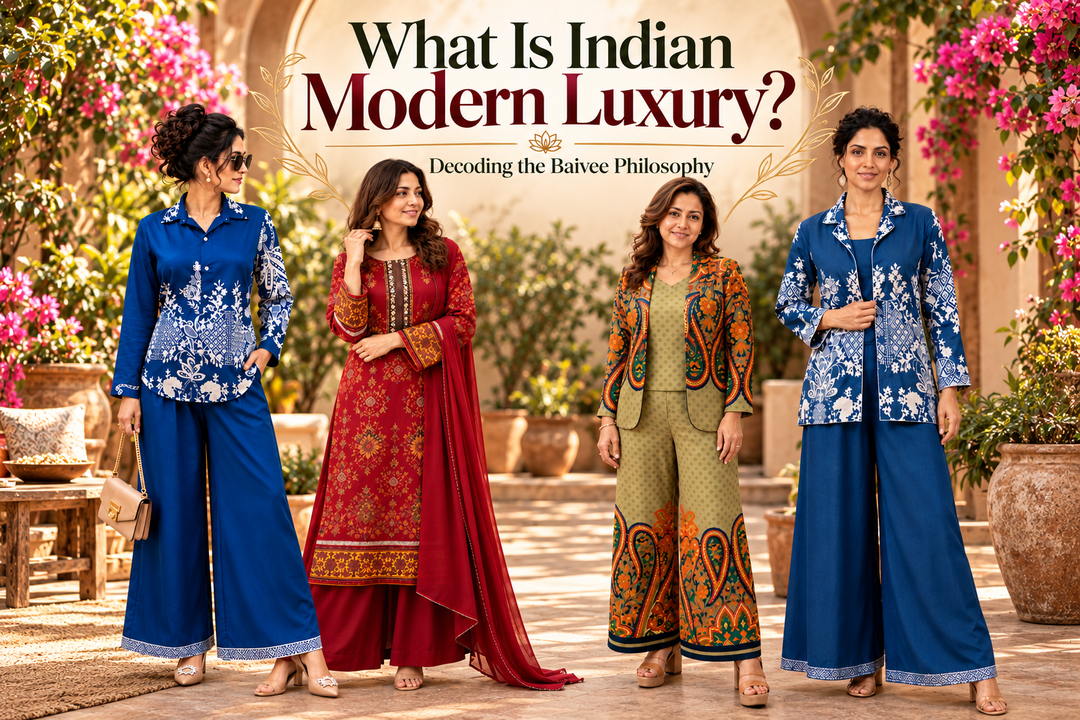
Indian modern luxury is the idea that true Indian luxury fashion lives in restraint, craft and comfort rather than in noise, and it is the idea that sits at the heart of everything we make at Baivee. After two decades of writing about clothes, I have watched the meaning of the word luxury change more in the last five years than in the twenty before them. It used to shout. Today it whispers, and the women who understand that whisper are the ones shaping the future of Indian fashion.
If you have ever stood in front of a wardrobe full of clothes and still felt you had nothing that truly represented you, this conversation is for you. We will look at where luxury in India comes from, how contemporary Indian fashion is rewriting its rules, and why quiet luxury for women feels so natural in our culture. Along the way, I will explain the thinking behind Baivee, a label built on this very belief. You can read more about who we are on our About page, or explore the full collection on the Baivee homepage whenever you feel like seeing these ideas in fabric.
I should say plainly that this is not a blog about expensive things. Price and luxury are cousins, not twins. A garment can cost a great deal and feel hollow, and another can cost thoughtfully and feel like a gift to yourself every time you wear it. What follows is my attempt, as someone who has spent a career watching Indian fashion evolve, to explain the difference in a way that is useful, honest and a little bit personal.
A Straight Answer: What Is Indian Modern Luxury?
Let us begin with the simplest possible definition, because a good definition is the most useful thing a reader can carry away. Indian modern luxury is a design philosophy that combines India’s deep textile and craft heritage with modern silhouettes, refined minimalism and everyday wearability. It values quality of cloth, precision of cut and emotional longevity over logos, trends and ornamentation for its own sake.
Notice what that definition does not say. It does not say that luxury must be bridal. It does not say that it must be heavily embroidered, or covered in zari, or reserved for weddings. For generations, Indian luxury clothing was mentally filed under occasion wear, the kind of clothes that came out of the cupboard for a ceremony and went back in afterwards. Indian modern luxury breaks that filing system. It says the finest thing you own should be something you can wear on a Tuesday.
There are four qualities I look for whenever I try to judge whether a piece belongs to this world. The first is material honesty, meaning the fabric looks and feels exactly as good as it claims to be. The second is structural intelligence, which means the cut flatters the body without fighting it. The third is restraint, the confidence to leave out the extra button, the extra border, the extra shimmer. The fourth is longevity, the quiet promise that the garment will still feel right three years from now.
When all four are present, you are looking at modern luxury fashion in its truest form. When even one is missing, the piece may still be pretty, but it is not luxury. That framework will help you again and again, whether you are browsing a boutique, scrolling through an online store or simply editing your own wardrobe.
How Indian Luxury Fashion Got Here
To understand where Indian luxury fashion is going, it helps to see where it has been. India has one of the oldest luxury textile traditions in the world. Muslin so fine it was said to pass through a ring, brocades woven with real metallic thread, shawls that took a year to complete, block prints carved by hand and dyed in natural colours. Long before the word luxury brand existed, Indian weavers and artisans were producing objects that rulers and traders travelled continents to acquire.
For most of history, then, Indian luxury meant royal patronage and ceremonial grandeur. It was visible, ornate and tied to occasion. Colour was bold, gold was generous and the idea of understatement would have seemed almost strange. That was not a flaw. It was a reflection of what the culture was celebrating and who was commissioning the work.
The twentieth century complicated things. Mass manufacturing arrived, tastes globalised and aspiration shifted toward imported labels. For a while, luxury in India was assumed to be something that came from elsewhere. The country’s own textile wealth was celebrated in museums and festivals but often overlooked in everyday premium wardrobes.
Then came the rise of the Indian designer. A generation of creators began to treat Indian craft as a modern language rather than a historical relic. They reinterpreted the sari, the kurta and the lehenga for contemporary life and showed that Indian designer clothes could stand shoulder to shoulder with anything produced abroad. This period gave us the confidence to say that luxury brands from India do not need to borrow their vocabulary from anywhere else.
The current chapter is quieter and, I would argue, more interesting. A new wave of labels is asking not how to make Indian clothing look grand, but how to make it feel right. They are blending Indian sensibility with modern western clothing structures, tailoring, clean lines and neutral palettes. They are designing for the woman who goes from a boardroom to a family dinner without wanting to change her entire identity in between. This is the space in which Indian modern luxury has found its voice.
The Landscape: Luxury Brands in India Today
If you search for luxury brands in India, you will find a layered and fast moving landscape. At one end are the international houses, the luxury brands available in India through flagship stores in major cities and premium malls. These labels have built their reputation over a century or more, and they bring a certain universal language of status with them.
At the other end are the homegrown names. Indian designer brands have grown from small ateliers into recognised creative voices, and several now sit comfortably among the top luxury fashion brands in India. Some specialise in bridal and couture. Others focus on ready to wear. Some are rooted in a single craft, such as chikankari, ikat or Banarasi weaving, while others are defined by a point of view rather than a technique.
Luxury is also broader than womenswear. Today you can find luxury menswear brands in India that reinterpret the bandhgala and the sherwani with tailored precision. There is a growing set of luxury kidswear brands in India as well, where parents invest in soft organic cloth and heirloom quality festive pieces. The category has widened to include luxury lifestyle brands in India that extend into home, fragrance, jewellery and accessories. The conversation about premium clothing brands in India is no longer small.
What matters for the shopper is understanding how these categories differ in intent. Heritage houses sell history and status. Couture designers sell spectacle and occasion. A new group of contemporary labels sells daily elegance, and this is the group that interests me most. When people search for luxury clothing brands in India, the most useful question to ask is not which label is biggest, but which label matches the life you actually lead.
The internet has transformed this decision. A few years ago, a woman in a smaller city had little access to premium Indian fashion unless she travelled. Today, luxury clothing online India has become a real category, with brands offering detailed fabric information, honest photography, size guidance and reliable delivery. Searching for luxury brands online India or Indian designer clothes online is now a normal part of how an informed buyer discovers new labels. That access is one of the most democratising things to happen to Indian fashion.
Why Quiet Luxury for Women Feels So Natural in India
The phrase quiet luxury entered global fashion vocabulary as a reaction against logo heavy dressing. In the Indian context, I think the concept has always existed. It is simply that we did not have a catchy name for it. Think of your grandmother’s well worn handloom sari, the one she saved for special days but also wore with dignity at home. Think of a mother who owned five perfect cotton kurtas and knew exactly how to wear them. That is quiet luxury, long before the phrase.
What has changed is that younger women are consciously choosing it. Quiet luxury for women today means clothes that do not need to announce themselves. A well cut ivory blazer. A fluid kurta pant set in a muted shade. A co ord set whose fabric catches the light softly. A shrug that drapes beautifully without a single embellishment. These are quiet luxury outfits, and they succeed because everything about them is considered.
There is also a practical reason this approach resonates in India. Our lives are layered. A single day can include a meeting, a family visit, a festive lunch and an evening out. Clothing that moves across these settings is not just stylish, it is economical in the best sense. It respects both your time and your budget. A woman who builds her wardrobe around a handful of high quality, versatile pieces spends less over the years and dresses better.
Climate plays a part too. India’s weather asks for breathable fabrics and intelligent layering, which is why natural fibres, soft drapes and relaxed tailoring come so easily to Indian designers. The best modern Indian clothing does not fight the climate. It works with it, and this is a form of luxury that imported minimalism cannot replicate.
And then there is emotion. In a culture where clothes carry memory, from the sari you received at a wedding to the shawl your aunt gifted you, the idea of buying something meaningful and keeping it for years is deeply familiar. Quiet luxury is not a foreign trend. It is a return to a value we already hold, expressed in a contemporary language.
Decoding the Baivee Philosophy
Every brand has a product. Very few have a belief. Baivee was built on one simple conviction: a woman should never have to choose between who she has become and where she comes from. That sentence sounds gentle, but it carries a quiet challenge to how Indian fashion has traditionally spoken to women, and it is the key to understanding everything we design.
What If Restraint Was the Real Celebration?
For generations, festive dressing in India meant more. More embroidery, more embellishment, more obvious symbols of tradition, all worn to prove that an occasion mattered. There is real beauty in that heritage, and it deserves respect. But somewhere along the way, the idea took hold that celebration had to be loud to be sincere.
Baivee asks a different question. What if restraint was the real celebration?
What if the most confident thing a woman could wear to a festive evening was not the heaviest garment in the room, but the best considered one? This is the heart of Indian modern luxury as we practise it. It does not reject tradition. It edits it, with care, until only what truly matters remains.
The Woman We Dress
Every design begins with a person, not a trend. The Baivee woman is educated, earning, independent, responsible, confident and contemporary. She has built her life on her own terms, and she has never needed to leave her roots behind to do it.
She does not need heavy embroidery to prove her festivity. She does not need excessive shine to prove her celebration. She does not need a conventional bridal silhouette to prove her Indianness. Her luxury is in the cut. Her Indianness is in the detail. Her confidence is in the way she wears it.
You will recognise her moments immediately, because you have probably lived them yourself:
Arriving at a Diwali dinner straight from work
Hosting friends at home
Standing at an intimate family celebration
Attending a festive corporate evening
Celebrating herself, simply because she wants to
None of these moments ask her to become someone else. That is the point. She does not dress up for the occasion. The occasion simply meets her, as she is: polished, sophisticated and unmistakably Indian.
24+ Years of Craftsmanship Behind Every Piece
A philosophy is only as believable as the hands that carry it out. Behind every Baivee piece lies more than two decades of understanding Indian textiles, construction and detail. That depth of experience is what allows us to simplify without losing richness, because you can only remove the unnecessary once you truly know what is essential.
We work closely with artisans and skilled tailors to bring modern silhouettes to life using honest Indian craftsmanship and luxurious fabrics. The word honest matters here. It means the craft is real, the finish is genuine and nothing is added merely for show. The result is clothing that feels considered rather than decorated, which is the finest compliment a luxury garment can earn.
If you would like to see how this thinking translates into styling, layering and fabric choices, our Baivee blog explores these ideas in practical detail.
Three Lines That Define Everything
Our entire design philosophy fits into three short lines. They are simple to remember and demanding to live up to.
One: Modern silhouettes, not conventional ones. We design for how women live today. Cuts are clean, proportions are fresh and every silhouette moves comfortably between work, family and celebration.
Two: Indian craftsmanship, not obvious motifs. Heritage appears in the quality of the weave, the precision of the stitch and the subtlety of the detail, rather than in familiar patterns repeated for recognition. Culture is felt, not announced.
Three: Quiet luxury, not excess. Luxury here is measured in fabric, fit and finish. It is the confidence to leave something out, and the discipline to make everything that remains exceptional.
Taken together, these three lines answer the question this entire blog began with. Indian modern luxury is not a style, a price point or a passing trend. It is a way of honouring a woman’s past and present at the same time, and trusting her to wear both with ease.
What is Indian modern luxury?
Indian modern luxury is a design approach that blends India’s textile and craft heritage with contemporary silhouettes, minimalism and everyday comfort. It prioritises fabric quality, fit, restraint and longevity over logos and heavy ornamentation.
How is Indian luxury fashion different from traditional Indian bridal wear?
Traditional bridal and couture wear is designed for ceremonies and is often richly embellished. Indian luxury fashion in its modern form focuses on refined everyday and occasion wear that can be worn repeatedly, such as blazer sets, co ord sets and kurta pant sets.
What does quiet luxury for women mean?
Quiet luxury for women means dressing in well made, understated clothes that rely on cut, fabric and fit instead of visible branding. Neutral palettes, clean lines and timeless silhouettes are its hallmarks.
Which are the top luxury fashion brands in India?
The landscape includes international houses with stores in major cities, established Indian designer brands and a growing group of contemporary labels. The best choice depends on whether you want couture, ready to wear or everyday modern luxury, so compare brands by fabric, fit, craft and philosophy rather than reputation alone.
Can I buy luxury Indian clothing online with confidence?
Yes, if you check for detailed fabric information, honest photography, clear size guides and transparent policies. Brands that explain their materials and stand behind their quality tend to be the most reliable.
Is modern Indian clothing suitable for office wear?
Absolutely. Tailored blazer sets, refined kurta pant sets and structured co ord sets in breathable fabrics are well suited to modern business attire in Indian conditions.
What colours work best for a modern luxury wardrobe?
Neutrals such as black, ivory, cream and muted champagne gold are reliable foundations because they combine easily and look polished across occasions.
How do I make my wardrobe more sustainable and luxurious at the same time?
Buy fewer, better pieces, choose versatile silhouettes and natural or high quality fabrics, and care for your clothes properly. Longevity is the most sustainable form of luxury.
Closing Thoughts: Luxury, Redefined
After twenty years in this field, I have come to believe that the most luxurious thing a garment can do is disappear into your life so gracefully that you forget you are wearing it, while everyone else notices how well you look. That is the quiet magic of Indian modern luxury. It is not about proving anything. It is about feeling entirely like yourself, in clothes that respect your time, your culture and your intelligence.
The Baivee philosophy exists to serve that feeling. Considered simplicity, fabric first thinking, purposeful versatility, cultural confidence and longevity are not trends. They are principles, and principles outlast seasons. Whether you are building your first thoughtful wardrobe or refining one you have curated for years, I hope this guide gives you a clearer lens for choosing what deserves a place in it.
If you have questions about our collections, need help with sizing or styling, or simply want to share your thoughts on what luxury means to you, we would love to hear from you. Reach out through our Contact page and let us continue the conversation. Luxury, after all, is always better when it is shared.