


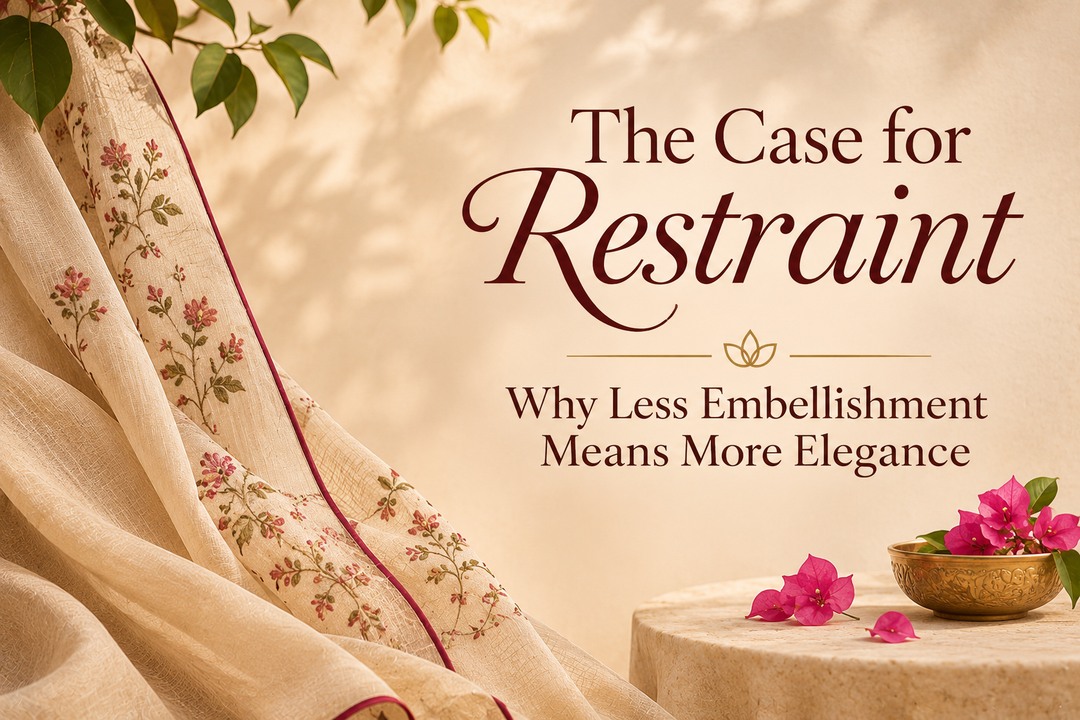
Minimalist fashion is the art of letting a garment speak softly, and in luxury ethnic wear and modern ethnic wear that quiet voice is often the most convincing one in the room. After more than twenty years of writing about clothes, craft and the women and men who wear them, I have come to believe that the most elegant outfit is rarely the busiest one. It is the one where nothing is accidental.
That belief sits at the heart of how we think about dressing today. If you have ever scrolled through the shop at Baivee and felt a strange calm settle over you, you already understand the argument I am about to make. Clean lines, honest fabrics and a refusal to decorate for decoration's sake are not a limitation. They are a point of view, and a very confident one.
So let us make the case properly. In this guide we will look at what minimalist style truly means, where restraint has always lived inside Indian clothing, why we drifted toward excess, and how you can build a wardrobe of minimalist clothing that feels rich, personal and entirely your own. Whether you love a modern anarkali dress, a sharply cut kurta, or a beautifully simple salwar suit, the principle is the same: less embellishment, more elegance.
What does minimalist fashion actually mean?
In simple terms, minimalist fashion is a way of dressing that favours clean silhouettes, considered fabrics, a restrained colour palette and very little surface decoration. It values quality over quantity and intention over impulse. The goal is not to look plain. The goal is to look resolved.
People often confuse minimalist clothing with boring clothing, and that is the first myth worth retiring. A minimal outfit can be rich in texture, subtle in drape and extraordinary in construction. The difference is that the richness lives inside the garment rather than on top of it. A heavy silk that falls beautifully, a hem that moves exactly as it should, a neckline cut with a quiet precision: these are the details that make minimalism feel luxurious rather than empty.
It also helps to separate minimalist style from minimalism as a lifestyle trend. You do not need to throw away your wardrobe, own thirty items or live in a white room to enjoy minimalism and clothes. Minimalist dressing is simply the habit of asking one question before you buy or wear anything: does this earn its place? If the answer is yes, it stays. If the answer is only because it is loud, it probably does not.
A useful way to remember it is this. Maximalism asks what more can be added. Minimalism asks what can be taken away without losing the soul of the piece. Both are valid, but only one of them tests the quality of the garment, because there is nowhere for weak tailoring to hide.
Is minimal clothing the same as minimalist clothing?
You will see both phrases used, and in everyday conversation they point to the same idea. Strictly speaking, minimal clothing describes how little a garment has in terms of design elements, while minimalist clothing describes the philosophy and the person choosing it. A minimal outfit is a thing. A minimalist look is a decision.
This small distinction matters because it shifts the focus from the garment to the wearer. Anyone can pick up a plain kurta. A true minimalist fashionista knows why that kurta is plain, why its sleeve length is exactly right, and why the fabric was chosen over a dozen others. The simplicity is informed, and informed simplicity is what separates a considered wardrobe from an empty one.
Restraint was never foreign to Indian clothing
Here is something that often gets lost in the loud noise of modern festive shopping: restraint has a long and distinguished history in Indian dress. A handwoven cotton sari with a plain border, a crisp white chikankari kurta worn with nothing else, a single strand of pearls against a bare neckline, a muted silk that needs no zari to prove itself. These are not recent inventions. They are the quiet vocabulary of a civilisation that understood the value of understatement long before the word minimalism existed.
Think of the white kurta. For generations it has been the default of scholars, artists and thinkers, precisely because it asks for nothing. A modern white kurta design for a woman carries that same legacy, but with a contemporary cut: a longer line, a relaxed sleeve, a clean placket. It is among the simplest garments in the Indian wardrobe, and also among the hardest to get right, because there is no embroidery to distract the eye from a poor proportion.
The same is true of textile traditions that rely on weave rather than decoration. A well made paithani speaks through its pallu and its colour. A good handloom speaks through its hand feel. When we talk about modern paithani kurtis today, the most interesting versions are often the ones that borrow just a sliver of that heritage, a single woven border or a hint of the traditional peacock motif, and let the rest of the garment stay calm. That is restraint applied to heritage, and it is exactly where modern ethnic wear becomes truly exciting.
So why did we drift toward embellishment?
It would be unfair to blame anyone for loving ornament. Indian celebration is joyful, and embellishment has always been part of how we mark an occasion. But somewhere along the way, especially in the age of fast retail and the endless scroll, decoration began to substitute for design.
When a garment is covered in sequins, heavy borders and layers of trim, it can look impressive in a photograph and still fit poorly in real life.
Embellishment is the easiest way to add perceived value, and it is also the easiest way to hide a weak pattern, a hurried finish or an average fabric.
Over time, many of us learned to equate more with better, simply because more was everywhere.
There is also a very practical cost. Heavily embellished pieces are harder to restyle, harder to wear twice, and harder to fit into the rest of your closet. They tend to belong to one moment, one event, one photograph. A restrained piece, on the other hand, can be a dinner outfit on Friday and a meeting outfit on Monday. That versatility is not a compromise. It is one of the finest forms of luxury, because it respects your time, your money and your life.
The psychology of less: why restraint feels so good
There is a reason a calm, well cut outfit makes you stand a little straighter. When the eye does not have to work, the mind relaxes. A clean silhouette reads instantly as confident, because it signals that the wearer does not need to prove anything.
Fashion psychologists often speak about decision fatigue, the quiet exhaustion that comes from too many choices. A minimalist closet reduces that load dramatically. When every piece works with several others, getting dressed stops being a daily negotiation and becomes a small, pleasant ritual. You reach in, you choose, you leave the house feeling put together. That ease is something no amount of embroidery can buy.
There is also the matter of how others perceive you. A restrained outfit tends to draw attention to the person rather than the clothes. People remember your face, your voice, your presence. In professional and social settings alike, that is often exactly the impression you want to leave. The clothes become a supporting character, and you remain the story.
The five principles of elegant restraint
Over the years I have noticed that the most graceful minimalist clothing design follows a handful of consistent principles. Understanding them will help you shop better, style better and edit better.
1. Silhouette comes first
In minimalist fashion the outline of the garment does most of the talking. A beautifully proportioned straight kurta, a flowing anarkali with a restrained flare, a precisely cut sharara kurti with clean lines: each of these works because the shape is right. When you shop, look at the garment as a shape before you look at it as a surface. If the silhouette is not flattering on its own, decoration will not rescue it.
2. Fabric is the real ornament
When you remove embroidery, fabric steps forward. This is where luxury ethnic wear reveals itself. Look for the way a fabric drapes, how it catches light, how it feels against the skin and how it behaves after a long day. A modern organza kurta design, for example, can be astonishingly elegant when the organza is crisp, translucent and finished cleanly at the edges, with no embellishment at all. The material itself provides the drama.
3. Colour stays disciplined
A restrained palette is the quickest route to a polished look. Ivory, black, stone, sand, deep olive, muted champagne gold and soft cream can be combined almost endlessly. When colours sit in the same quiet family, every piece in your wardrobe becomes compatible with every other. That is the secret behind the effortless minimalist look you admire on others.
4. Detail is edited, not eliminated
Minimalism does not ban detail. It selects it. A thread worked button, a hand finished hem, a single line of tonal embroidery along a neckline, a perfectly cut sleeve: these are details that reward closer looking. The rule is simple. One thoughtful detail beats ten decorative ones. Choose the one that matters and let the garment breathe around it.
5. Construction is non negotiable
The less a garment has on its surface, the more its construction matters. Seams must sit flat, lines must hang true, and the fit must feel considered. This is why a minimalist fashion designer is often judged more rigorously than a decorative one. There is simply nowhere to hide. If you want to understand the quality of a brand, study its simplest piece.
Restraint inside a design philosophy
It is worth pausing to see how this thinking shapes a collection from the very first sketch. In our piece on the design thinking behind a festive edit, we explored how even a celebratory season can be approached with discipline: choosing a silhouette first, a fabric second and a finish last, rather than starting with decoration and working backwards. That sequence is the quiet engine of elegant clothing.
And if you want to understand the larger idea behind it, our reflection on what Indian modern luxury really means explains why modern silhouettes, honest craftsmanship and quiet luxury can sit together so comfortably. In that philosophy, restraint is not the absence of celebration. It is the most grown up way of celebrating.
What does restrained modern ethnic wear look like for women?
This is where the conversation becomes delightfully practical. Modern ethnic wear for women has never had more range, and restraint can be expressed in every category of the wardrobe. Let us walk through the pieces most of us actually reach for.
Kurtas and kurtis
The kurta is the backbone of the Indian closet, and modern kurtas for ladies show restraint beautifully. Look for a clean neckline, a considered length, side slits that sit at a flattering point and sleeves that fall with intention. Modern kurtis for ladies in solid colours, tonal threadwork or a single woven stripe will outlast a season of trends because they never relied on a trend to begin with.
Modern short kurtis deserve a special mention. Paired with straight trousers, wide leg pants or even tailored denim, a short kurti becomes a smart, contemporary separate. The secret is proportion. Keep the hem at a deliberate point, let the fabric sit cleanly on the shoulder and avoid piling on prints or trims. The result is a minimal dressing style that works from a morning meeting to a late lunch.
Necklines are where tiny decisions create big elegance. Modern sleeveless kurti neck designs, whether a clean round, a soft V or a structured boat neck, show off the collarbone and shoulder line without a single bead. Because a sleeveless cut exposes so much of the wearer, the neckline has to be perfectly balanced. When it is, the garment needs no embellishment at all.
The floral question
Can a print belong in a minimalist wardrobe? Absolutely, with one condition: restraint in scale and palette. Modern floral print kurti designs that use a small, tonal botanical repeat on a soft ground feel airy and graceful. It is the loud, high contrast, all over print that fights with everything else you own. Choose florals the way you would choose a good perfume, subtle enough that people lean in rather than step back.
Anarkali, salwar suit and sharara
A modern anarkali dress is proof that volume and restraint can share a hanger. The magic lies in the flare. A softly gathered, floor skimming silhouette in a single colour, perhaps with a thin tonal border, can look more regal than a heavily worked version. The fabric does the swirling and the garment does the speaking.
The same applies to the beautiful salwar suit. A modern salwar suit, and the many modern salwar suit designs now available, can feel fresh when the kurta is cut cleanly, the bottoms are tapered or straight, and the dupatta is light, plain or finished with only a delicate edge. Instead of a heavy dupatta carrying all the decoration, let a soft, fluid one frame the face. It is a small change with a large effect on how modern the whole outfit feels.
A modern sharara kurti gives you a lovely contrast of shapes. The relaxed, flared sharara balances a structured kurta, and when both are kept in the same colour family the outfit reads as a single, graceful column of fabric. It is festive without effort and elegant without noise.
Lehenga and half saree
It may sound surprising, but even the most celebratory silhouettes can be approached with restraint. A modern lehenga online is easiest to judge when you imagine it with the embellishment removed. Does the skirt still fall beautifully? Is the blouse still cut with precision? If so, you have found a lehenga worth owning. Pale, tonal and softly structured lehengas have become a favourite for those who want ceremony without spectacle.
Modern trendy half saree designs follow the same logic. A half saree in a monochrome palette, with a simple border and an elegantly pleated drape, honours tradition while looking entirely contemporary. The trick is to resist the urge to fill every inch. Let the pleats, the fall and the border do the work.
Organza and paithani, revisited
Two textiles that illustrate our argument best are organza and paithani. A modern organza kurta design in ivory or soft blush needs only good tailoring and a lining that lets the fabric glow. Meanwhile, modern paithani kurtis can honour a great weaving tradition through a single border or a small panel of woven motifs, letting the base cloth remain gentle. In both cases, the lesson is identical: choose the extraordinary material, then step back.
Restraint in modern ethnic wear for men
It would be a mistake to treat this as a purely womenswear conversation. Modern ethnic wear for men has quietly become one of the most interesting spaces in Indian fashion, and it is naturally suited to restraint. A well cut kurta in linen, cotton silk or a fine handloom, worn with tapered trousers or a clean churidar, is the very definition of a minimal outfit for men.
Modern mens ethnic wear does not need heavy embroidery to look celebratory. A bandhgala in deep charcoal, a plain sherwani in ivory with just a tonal collar detail, or a long kurta layered under a structured jacket can carry a wedding as comfortably as a boardroom. Colour discipline helps here too. Earthy neutrals, deep jewel tones used sparingly and monochrome combinations feel assured and grown up.
For anyone building minimalist attire in the Indian tradition, the principle remains consistent across genders. Fit first, fabric second, finish third, decoration last, and often not at all. Modern ethnic attire for both men and women gains its authority from precisely this discipline.
The quiet comfort of designer night suits
Here is a category that rarely gets its due. Designer night suits sit at the intersection of comfort and craft, and they are a wonderful place to practise minimalism. Soft cotton, fluid modal, smooth satin and delicate silks in muted tones make for sleepwear and loungewear that feels indulgent without any ornament.
The best designer night suits are cut with the same care as daywear. A relaxed straight kurta with matching trousers, a clean piped edge, a mother of pearl button and a fabric that feels cool against the skin can turn an ordinary evening into something gently ceremonial. They are also surprisingly versatile. Many can double as lounge sets for a quiet morning at home or an easy weekend with family.
Can minimalism and maximalism live together?
A fair question, and one I am asked often. Is a maximalist outfit the enemy of elegance? Not at all. Maximalism, at its best, is a deliberate celebration of colour, pattern and abundance, and it has its own discipline. The trouble begins when abundance is unedited, when every element competes and nothing leads.
The most graceful approach is to choose one hero for each look. If you wear a richly worked dupatta, keep the kurta plain. If you love a bold statement necklace, keep the neckline clean. If you adore a vivid colour, wear it in one place and let everything else retreat. You are borrowing the generosity of maximalism and the clarity of minimalism at the same time, and the result is an outfit with personality and poise.
Think of restraint as the editor of your style. It does not tell you what to love. It simply makes sure that what you love is heard properly.
How to build a minimalist closet, step by step
Minimalist closets are not built in a weekend, and they should not be built in a panic. Here is the approach I have shared with clients and readers for years.
Start by looking, not buying
Open your wardrobe and notice what you reach for again and again. Those repeat choices reveal your true style. Most of us wear a small portion of what we own, and that portion usually shares a shape, a colour family or a feeling. Begin there.
Define your palette
Choose three to five core colours that flatter you and suit your life. For many people this means ivory, black, a warm neutral, one deeper tone and one soft accent. A defined palette is the fastest way to turn a collection of clothes into a wardrobe.
Invest in foundational pieces
Build around versatile pieces: a few perfectly cut kurtas, a pair of well fitted trousers, an elegant straight suit, one modern anarkali dress for occasions, a lightweight dupatta and a reliable layer. Clothing for minimalists works best when each item can pair with at least three others.
Prioritise fabric and fit
Because there is little decoration, quality is visible. Touch the fabric. Check the seams. Try it in motion. A minimalist fashion designer will tell you that a garment should look as good when you sit, walk and reach as it does on a hanger.
Edit gently and regularly
Once or twice a year, review your closet. Let go of what no longer serves you, repair what is worth keeping and note the gaps. Minimalism is an ongoing conversation with your own taste, not a one time purge.
Common mistakes people make with minimalist dressing
Even good intentions can go astray, so let me save you some trouble. The first mistake is confusing minimalist with cheap. Restraint depends on quality, and a thin, poorly finished plain garment will always look unfinished. The second is ignoring texture. Without pattern or embellishment, texture is what creates depth, so mix a crisp cotton with a soft silk or a matte weave with a subtle sheen.
The third is forgetting fit. A loose garment can be gorgeous, but only when the looseness is designed. The fourth is going too far into one colour without relief. A single tone can be beautiful, but a touch of contrast in an accessory, a lining or a dupatta keeps the look alive. And the fifth, perhaps the most common, is following minimalism as a rule rather than as a feeling. If a piece makes you joyful and you wear it well, it belongs, whatever the rulebook says.
Frequently asked questions
What is minimalist fashion in simple words?
Minimalist fashion is a style of dressing based on clean silhouettes, quality fabrics, neutral or restrained colours and very little surface decoration. It focuses on fit, material and craftsmanship rather than ornament.
Can ethnic wear be minimalist?
Yes. Luxury ethnic wear and modern ethnic wear can be wonderfully minimalist when they rely on silhouette, fabric and fine tailoring instead of heavy embroidery. Plain kurtas, tonal anarkalis and understated salwar suits are all excellent examples.
How do I start a minimalist wardrobe on a budget?
Begin by editing what you already own, then add one or two versatile, well made pieces at a time. A small number of quality garments in a cohesive palette is usually more economical than many impulse purchases.
Is minimalist clothing suitable for weddings and festivals?
Certainly. A tonal lehenga, a soft organza kurta set or a clean sherwani can look more refined at a celebration than a heavily decorated outfit. Choose one thoughtful detail and let the fabric carry the occasion.
What colours work best for a minimalist look?
Ivory, white, black, beige, stone, olive, navy and muted gold are reliable choices. Pick a few that flatter your skin tone and keep your palette consistent so pieces can be mixed freely.
Does minimalism mean I can never wear prints or embroidery?
Not at all. Minimalism is about intention. A subtle floral, a tonal thread detail or a single embroidered border can sit comfortably inside a minimalist wardrobe when it is chosen deliberately and not piled on.
The final word on restraint
When I look back over two decades of watching fashion cycle between excess and calm, one truth keeps returning. Elegance is not something you add. It is something you uncover, by removing everything that does not belong. A beautifully cut garment in a fine fabric, worn with ease and confidence, will always be remembered longer than one buried in decoration.
So the next time you stand in front of your wardrobe, or scroll through a collection, ask the gentle question at the heart of minimalist dressing: what can I leave out? The answer, more often than you think, is the secret to looking and feeling extraordinary. Restraint is not a smaller way of dressing. It is a larger, calmer and more confident one.
If you would like help finding the right silhouette, fabric or fit for your own minimalist wardrobe, we would love to hear from you. Please get in touch with our team and let us help you choose pieces that feel quietly, unmistakably like you.